Activated Bodies: Relationships with Sculptures and Encountering Identity

Updated: May 13
by Hans Van Hans
My identity is often encountered as something to be read quickly—judged, categorised, and resolved at a glance. This expectation is not incidental; it reflects a broader condition in contemporary visual culture, where visibility is mistaken for understanding. Transgender individuals are often expected to be visible—to show surgery scars or present some form of proof of physical “transition” or difference. Yet lived experience—particularly for many transgender people—reveals that identity is not immediate or easily categorised, but something that is felt, and that unfolds over time through relationships and interactions with others.

My identity is often encountered as something to be read quickly—judged, categorised, and resolved at a glance. This expectation is not incidental; it reflects a broader condition in contemporary visual culture, where visibility is mistaken for understanding. Transgender individuals are often expected to be visible—to show surgery scars or present some form of proof of physical “transition” or difference. Yet lived experience—particularly for many transgender people—reveals that identity is not immediate or easily categorised, but something that is felt, and that unfolds over time through relationships and interactions with others.
This tension shows mostly during moments of encounter. When we see something unfamiliar, we tend to quickly categorise it to make it legible and reduce uncertainty. My practice interrupts this impulse. Instead of offering a clear or stable image, it explores forms that aren’t immediately understandable, requiring touch, negotiation and time.
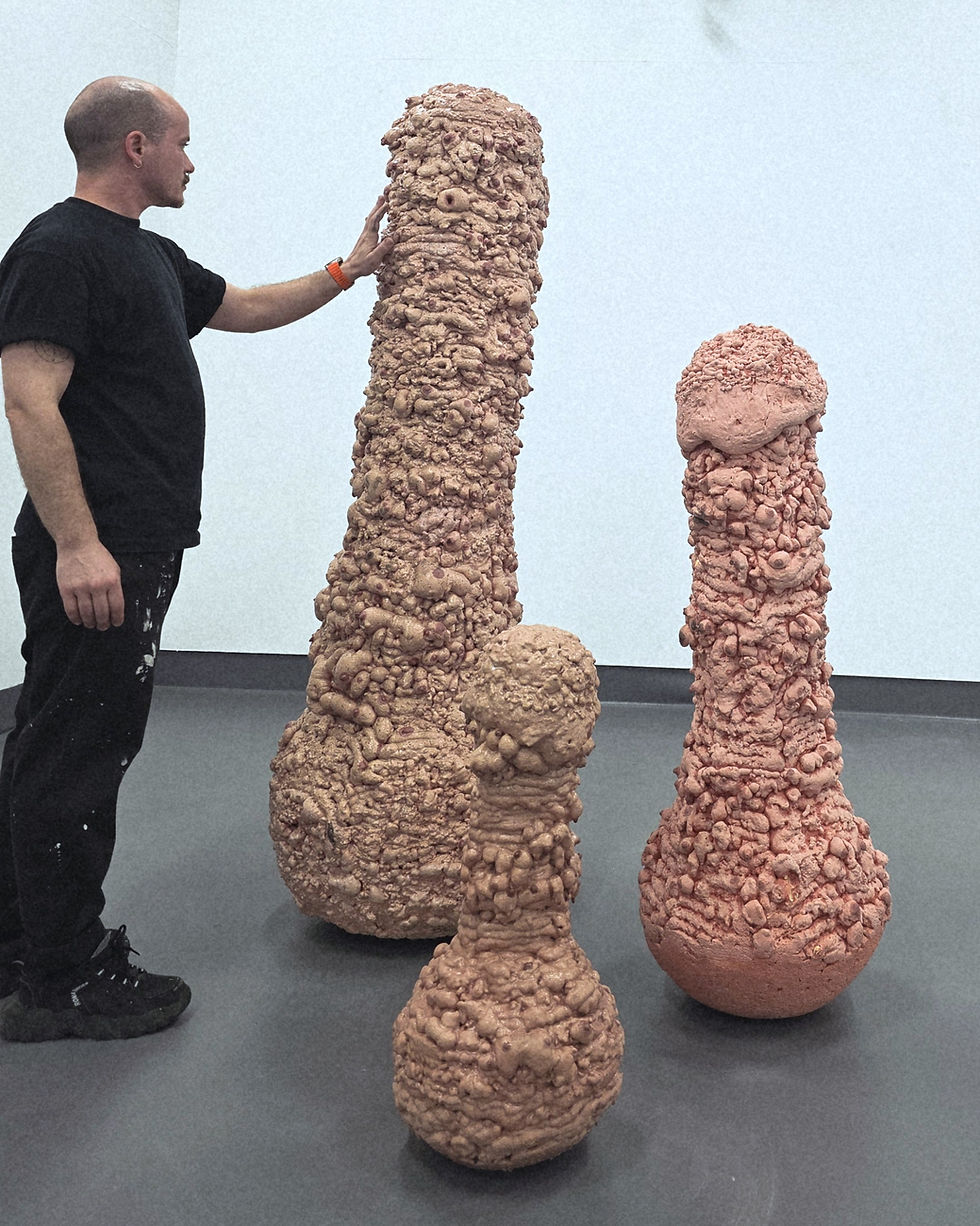
In my sculptural practice, I use abstraction to create interactive works that require physical engagement to understand them. Recent works such as Self-Portrait (Successive States) (2024–25), Cop-a-Feel (12 Months of Becoming) (2024–25), and Soft-Entry (2025) prioritise encounter over representation, focusing on experiencing identity rather than how it should appear.
My works are activated through touch. When people first approach them, their responses are often unsure—hesitation, laughter, uncertainty. Their hand reaches out, testing the surface. Often engaged lightly at first, then with more confidence. As the sculptures shift, compress, and return to form, something begins to change. The work is no longer simply looked at—it is being connected with.

When I initially presented one of the Self-Portrait (Successive States) sculptures in a critique, the responses were uncertain. People stood around it, laughing at the ridiculousness of the form presented to them—unsure how to begin to interpret what they were seeing. The form was both familiar and unfamiliar and difficult to place. It did not clearly present a body, yet it suggested a figure.
Responses began to shift once interaction was introduced. When participants realised they could touch the work, they approached it tentatively at first—testing it with small gestures and light pushes. As the sculpture wiggled, swayed, fell, and righted itself, participant behaviour changed. They became more engaged, more playful, and an active conversation began around the behaviour and experience.
The conversation around the work shifted from being seen as open and non-representational of a single body to one that reflected human characteristics. What had initially been read as strange or humorous began to be described in terms of playfulness, resilience and vulnerability. The work was no longer encountered as an abstract form, but as something with qualities—something that could be related to. In that moment, the work shifted from something abstract into something understood relationally. Watching this shift, I recognised a familiar feeling. The movement from confusion to understanding mirrors a common life experience—being misread on first encounter, then gradually understood over time, through interaction. What the sculpture was doing in that moment was not simply being interpreted but enacting a condition that othered identities already live within.
This shift is central. What begins as abstraction—unclear, unfamiliar, amusing—gradually becomes understood through behaviour. The viewer adjusts to the work as the work adjusts to them. Through this exchange, the form begins to register less as an object and more as an active relationship with another. There is a moment where the work shifts from something abstract into something that can be understood as human.
This process reflects a broader condition of relational identity. As David Getsy states, “one cannot be queer alone.” Identity is not formed in isolation, but through relation. I am only queer in relation to another. My difference is not self-contained—it is produced externally, through encounter, through being read, misread, and negotiated within social frameworks that precede me. In this sense, identity does not simply exist; it is continuously formed through relation. Difference emerges relationally—but so too does recognition.
This aligns with Gayle Salamon’s understanding of embodiment as lived rather than visually determinable, understood first and foremost as a felt perception, shaped through sensation, touch, and social interaction. Through touch and interaction, the sculptures are encountered as felt bodies rather than visual identifiers.

This is why my work does not illustrate this idea; it stages it. Rather than categorising identity visually, it creates situations in which it must be negotiated.
By encountering my work, behaviour becomes visible. Some participants remain cautious, testing the limits of the work. Others engage more directly, pushing, leaning, or sitting with greater force. These responses are not neutral—they reveal how individuals approach what they do not immediately understand. This is something I remain deeply aware of—not only as the maker of the work, but as someone who is routinely encountered in similar terms.
Drawing on D. W. Winnicott’s concept of play as a space where inner and outer realities meet, the installations operate as a form of “potential space.” Here, meaning is not fixed but emerges through interaction. The sculptures respond, but they are not fully controllable, creating a dynamic of negotiation between participant and object.
Humour often marks the entry point into this exchange. The forms suggest bodily references at enlarged scales, producing a moment of uncertain recognition. What initially appears strange becomes approachable through a humorously curious play.
Through this means, perceptions shift. Questions move from “What is this?” to “How do I relate to this?” In that shift, understanding is no longer based on visual recognition, but on the interaction and behaviour over time.
In broader social contexts, particularly in relation to transgender bodies, there is a persistent demand for clarity and immediate legibility. My work resists this expectation. It proposes that identity cannot be fully known at a glance, but is something felt and understood through relation.
Rather than presenting fixed representations of a “trans body”, my practice is focused on creating situations in which identity is understood and negotiated through contact and adjustment. Transgender embodiment is not something to be resolved visually, but something encountered relationally, responsively, and over time. My identity is not something you can see—it is something you come to know.

Comments