Beyond Legibility: Practice-Based Reflections on Participatory Abstraction and Trans Embodiment
- Hans Van Hans

- Apr 3
- 6 min read
Updated: May 13
by Hans Van Hans
Since 2014, I have witnessed a profound shift in transgender visibility. With this increased visibility has come intensified scrutiny, in which bodies are not only seen but also judged and politicised in real time. In a culture shaped by rapid visual consumption, identity is expected to be immediately recognisable. Transgender bodies are required to become legible, to prove coherence, and to confirm their position within stable binary categories.
This demand extends into governance, where bodies are required to declare and verify their identities to access public space, legal recognition, and cross-border movement. Trans existence is therefore framed through intelligibility: whether one passes, whether one can be read correctly, whether one conforms.
My work responds to this regime of enforced legibility by developing participatory abstraction as a mode of trans representation. Rather than presenting the body as an image to be read, I create sculptures that are encountered through touch, response, and relation.
In works such as Self-Portrait (Successive States) (2024–25), Cop-a-Feel (12 Months of Becoming) (2024–25), and Soft-Entry (2025), embodiment is not fixed in advance but is formed through material encounter.
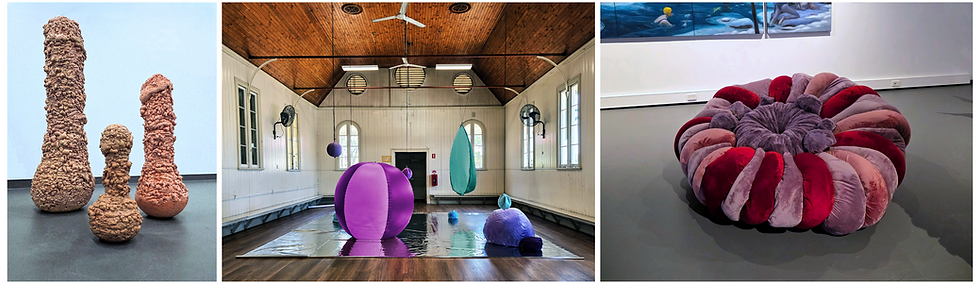
Fig.1 Self-Portrait (Successive States), (2024-25).
Fig.2 Cop-a-Feel (12 Months of Becoming), (2024-25).
Fig.3 Soft-Entry (2025).
Material Behaviour
The sculptures operate through material behaviour. Materials such as latex, foam, and inflatables respond directly to touch: they stretch, compress, resist, and recover. A push destabilises a form; sitting reshapes it. These responses are physical rather than representational, produced through direct interaction.

Rather than treating materials as passive, I work with their tendencies, allowing them to guide formal outcomes. Each material introduces constraints that cannot be fully controlled; they can only be worked with.
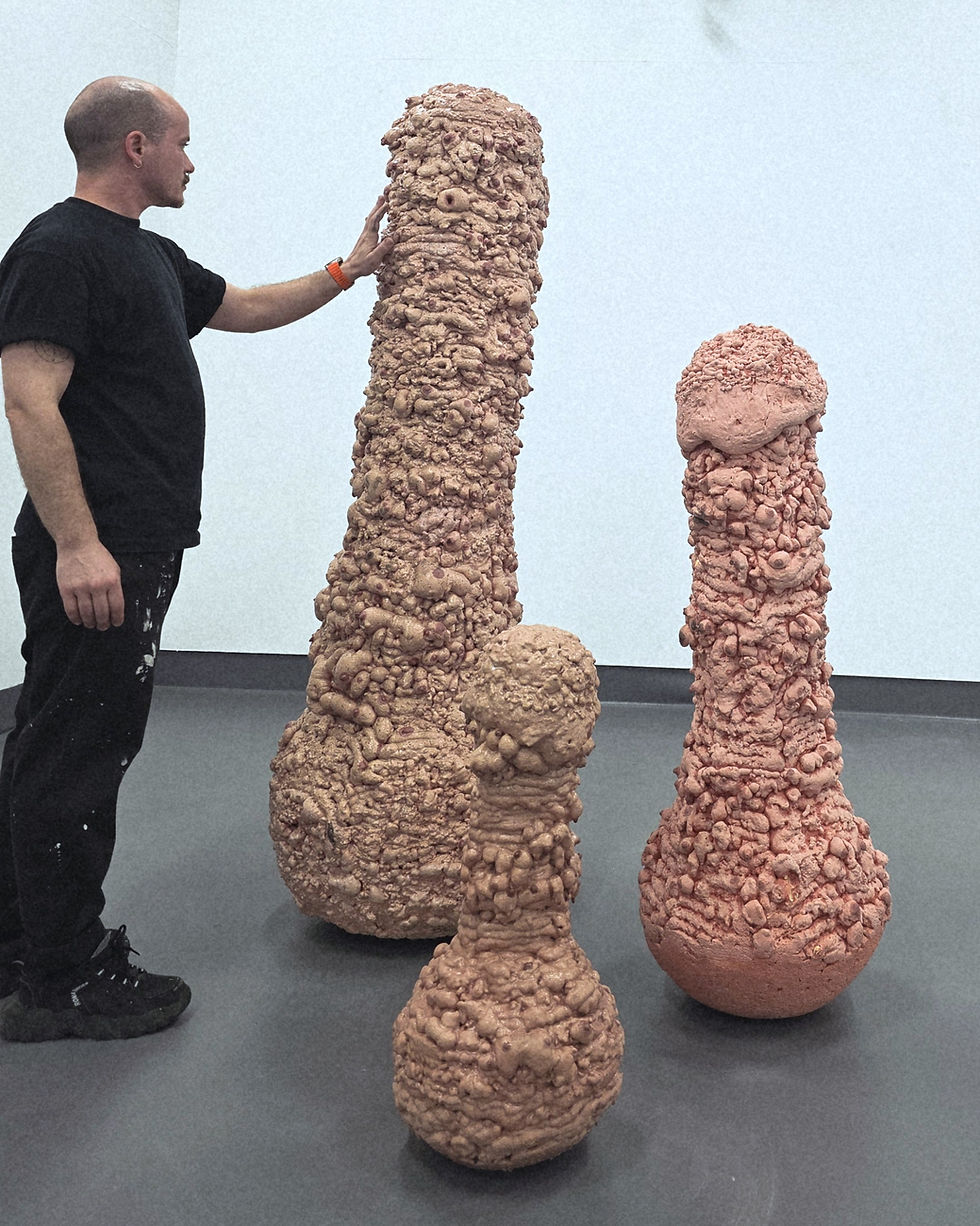
Expanding foam grows as it cures, swelling, leaking, and hardening in unpredictable ways. In Self-Portrait (Successive States), it pushed through structural gaps and formed protrusions reminiscent of breasts. Rather than correcting these outcomes, I retained them, allowing the accident to remain part of the work’s logic. This behaviour reflects embodiment as unstable and continually in formation.
Cement operates as a concealed counterweight within the base of each form. Its mass produces a constant downward force that determines orientation, enabling the sculptures to return to an upright position. While other materials bend, expand, or yield, cement stabilises through internal weight rather than visible structure. Strength here is not an external appearance, but an unseen quality embedded within the work.
Latex forms the outer surface of several works. Built up in layers, it produces a flexible yet resilient skin that stretches under pressure and returns to shape. Its surface is not immediately identifiable, and its tactile response often differs from expectation. It is slightly tacky, yielding before resistance returns. This produces a moment where what is seen and what is felt do not fully align—the sensation is familiar, but not identical to skin. This misalignment reflects a broader condition in the work, where bodily experience is not always confirmed by visual appearance.
In Cop-a-Feel, the same material system is used but reconfigured through colour. Saturated magenta and clinical green shift how the work is read, reducing its association with skin and changing how participants orient themselves toward the forms. Although material behaviour remains consistent, this shift produces a more direct mode of engagement. Colour here functions as part of the work’s material logic, shaping conditions of interaction rather than acting as surface decoration.
In Soft-Entry, latex is replaced with minky fabric and memory foam, selected for their tactile and behavioural qualities. Minky provides a soft, comforting surface, while memory foam responds to pressure by holding the body’s impression before slowly recovering. Together, these materials produce a structure that yields to the participant while also holding them in place, requiring slower, more careful movement. These qualities are only fully understood through sustained touch.
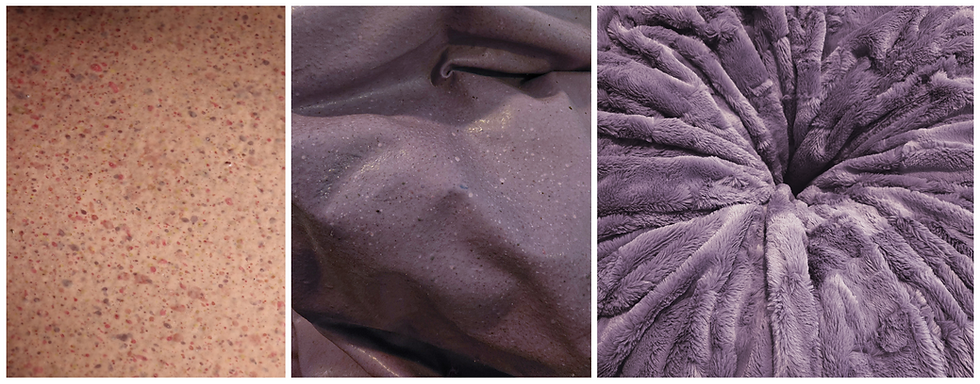
Fig.5 Detail image of latex layers on Self-Portrait.
Fig.6 Detail image of latex layers on Cop-a-Feel.
Fig.7 Detail image of minky fabric, Soft-Entry
Toy-based materials such as punching bags, beach balls, and pool noodles introduce pre-structured behaviours that shape movement, resistance, and response. Across the works, these built-in dynamics operate alongside material qualities that are understood through tactile and sensory engagement.
Material behaviour is therefore not a property of form alone, but the condition through which relational encounter is produced.
Participation as Method
Participation operates as a method in my work rather than a thematic concern. The sculptures are incomplete without interaction, as their meaning is produced through bodily engagement with material forms. Each work structures participation according to how material behaviour enables and constrains action.
Self-Portrait (Successive States) operates through unstable, self-righting forms that are pushed, toppled, and observed as they recover or fail to do so. Their behaviour structures repeated engagement through cycles of instability, collapse, and return.
Cop-a-Feel enables simultaneous participation through interconnected suspension points, where movement in one form directly alters another. Interaction is distributed across the system, producing shifting conditions of collective movement.
Soft-Entry produces a slowed encounter through memory foam and minky fabric, which compress, retain bodily imprint, and recover gradually. Participation here is shaped by sustained bodily adjustment rather than immediate action.
Across these works, participation produces distinct conditions of engagement rather than a single mode of interaction.
These encounters generate responses such as laughter, hesitation, discomfort, and tenderness. These are not secondary effects but part of how engagement is registered through the body.
This became clear through an interaction with Soft-Entry. A viewer approached the work and laughed at first. Sitting down, the experience shifted. The memory foam warmed beneath them and slowly formed to their body. As they adjusted their weight, the form responded—shifting subtly with their movement. What began as humour became quieter and more attentive, unfolding as a reciprocal adjustment over time.
This encounter demonstrates that meaning does not precede interaction but is produced through it.
As Gayle Salamon describes, this can be understood as the “felt body,” in which meaning emerges through sensation and lived experience rather than through visual recognition. Understanding is therefore grounded in bodily experience as it unfolds.
This relational condition aligns with D. W. Winnicott’s concepts of “transitional objects” and “potential space.” Transitional objects mediate between inner and external experience, while potential space describes the relational field in which meaning develops through play rather than being fixed in advance.
Within this framework, objects are neither fully internal nor fully external, but relational forms that sustain engagement without resolving it. My works operate in a similar way, maintaining conditions where interaction remains open and responsive.
Participation, therefore, is a structured method through which relational meaning is produced in time through material behaviour and embodied response.
Trans* Embodiment as Relation
In my work, transgender embodiment is produced through participatory abstraction as a relational condition rather than a representational image.
These conditions correspond to distinct modes of embodiment—resilience and adaptation, play and transition, vulnerability and attunement—which emerge through interaction rather than being predefined. They are not emotional states imposed on the viewer, but structural relations that shape how engagement unfolds between body and work.
Self-Portrait (Successive States) explores resilience through self-righting behaviour, where embodiment is enacted as continual adjustment rather than stability. Cop-a-Feel operates through collective negotiation, in which movement, colour, and spatial relation produce shifting conditions of interaction. Soft-Entry centres vulnerability and attunement, requiring sustained bodily adjustment within a responsive material field.
Across these works, trans embodiment is not represented as an image but produced through interaction between bodies, materials, and time.
This approach is informed by artists such as Lygia Clark and Eva Fàbregas, whose practices foreground bodily activation rather than visual interpretation. It also draws on David Getsy’s account of abstraction as having “transgender capacity,” in which embodiment is understood as open, successive, and continuously negotiated.
Extending this, my work proposes abstraction not as visual openness alone, but as a method for producing relational embodiment.
In this framework, embodiment is not formed in isolation but through encounter. As Getsy writes, “one cannot be queer alone.” Queerness is therefore produced relationally, just as transgender embodiment is shaped through its entanglement with normative cisgender frameworks.
Closing Reflection
My practice develops participatory abstraction as a mode of trans representation, in which embodiment is not made visible through depiction but produced through relation. Abstraction, in this sense, does not move away from the body but sustains it through touch, material response, and shared encounter.
Across Self-Portrait (Successive States), Cop-a-Feel (12 Months of Becoming), and Soft-Entry, embodiment is not illustrated or fixed in image but is enacted through distinct material conditions. Each work produces a specific participatory structure that frames how bodies, materials, and actions come into contact.
Rather than functioning as objects to be viewed, the works operate as sites of relation. The viewer is not external to the work but is drawn into its conditions, where attention and movement become part of how experience is formed.
This shifts trans representation away from regimes of visibility that demand immediate legibility toward practices in which understanding develops over time through sustained interaction. What is known is not given in advance but formed through encounter, where embodiment remains open and continuously negotiated.
Ultimately, participatory abstraction reconfigures representation not as depiction, but as relation. It offers a way of understanding trans embodiment through material engagement, where meaning is not represented but actively produced in the space between body, material, and time.


Comments